
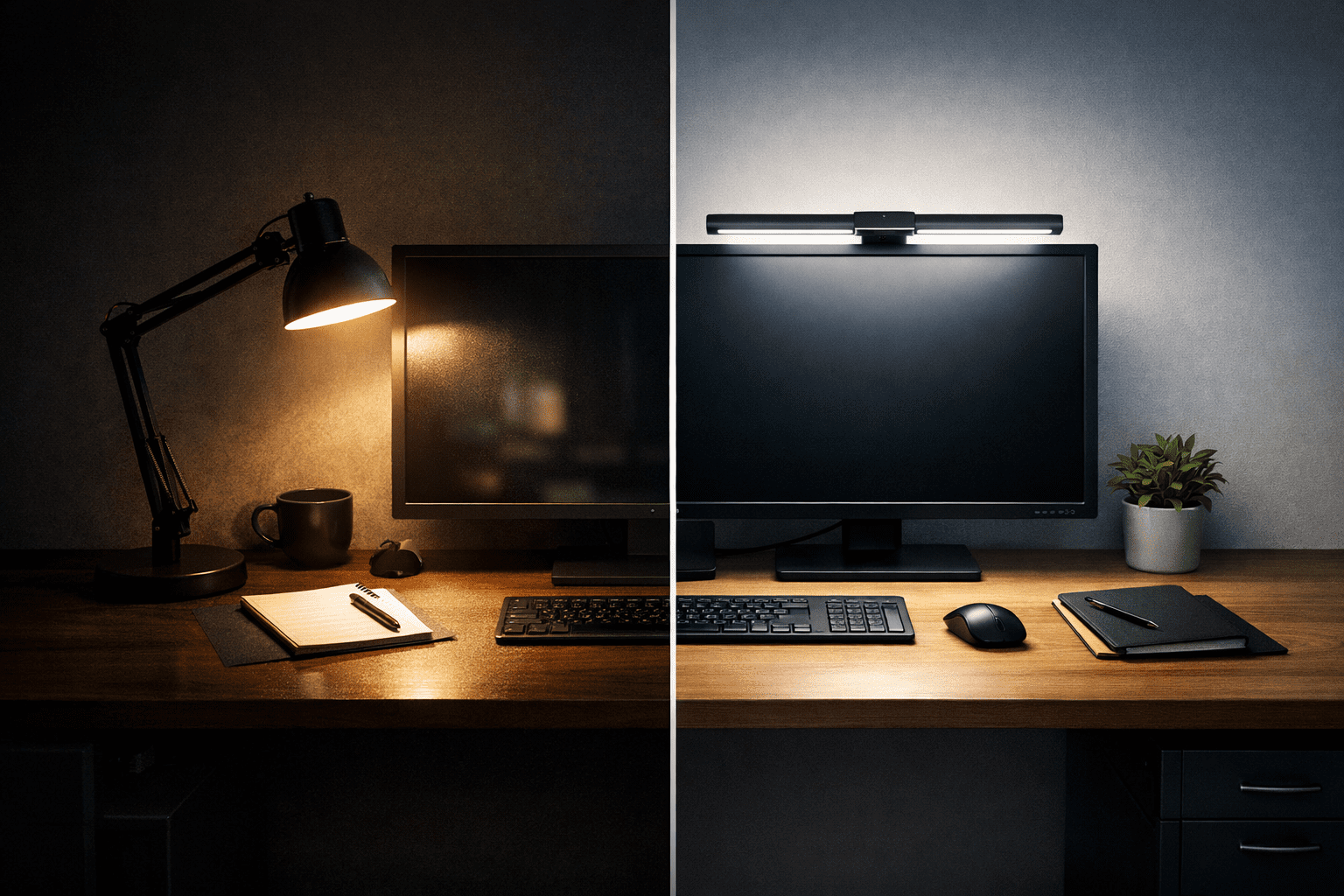

If you spend most of your day at a desk, you probably know this feeling.
At first, everything seems fine.
The screen looks normal.
The light is on.
You start working.
Then, a few hours later, your eyes feel heavier.
You adjust the lamp.
You move it a little.
It helps for a moment—then the discomfort slowly comes back.
This is where the comparison between desk lamps and monitor light bars usually begins.
That’s when people stop blaming the screen and start wondering if the lighting around it is part of the problem.
Contents
- 1 Why lighting becomes a problem over time
- 2 Desk lamps: why people still like them
- 3 Where desk lamps start to feel annoying
- 4 What changes with a monitor light bar
- 5 Why monitor light bars feel easier on the eyes
- 6 Desk space matters more than you think
- 7 Adjustments, controls, and daily use
- 8 So which one works better for long work hours?
- 9 Final thoughts
Why lighting becomes a problem over time
Lighting rarely feels wrong right away.
It becomes a problem slowly.
Your eyes keep adjusting between bright and dark areas.
The desk feels uneven.
The screen starts to feel harsher, especially at night.
You don’t notice these adjustments happening, but your eyes do.
After long work hours, that effort adds up.
That’s why lighting matters more than people expect—not because it’s dramatic, but because it’s constant.
Desk lamps: why people still like them
Desk lamps feel familiar.
Most people have used one at some point, so they don’t feel like a big decision.
They work well when:
- you read paper
- you write by hand
- you move around the desk a lot
- you don’t spend all day staring at a screen
A good desk lamp can light one area really well, and for some setups, that’s exactly what’s needed.
Where desk lamps start to feel annoying
The problem usually shows up when screens enter the picture.
Because desk lamps light from the side or from above:
shadows move when you move
glare appears on the monitor
one area looks bright while another stays dark
This is where the difference between desk lamps and monitor light bars becomes easier to notice.
You end up adjusting the lamp more than you want to.
Not because it’s broken—but because it’s not designed around screens.
Over long work hours, that uneven lighting becomes tiring.
What changes with a monitor light bar
A monitor light bar does something simple but important:
It changes where the light comes from.
Instead of lighting from the side, it sits on top of the monitor and shines down onto the desk.
That means:
- no light in your eyes
- no reflection on the screen
- more even lighting across the workspace
For many people, that feels better almost immediately.
Why monitor light bars feel easier on the eyes
The biggest difference isn’t brightness or features.
It’s consistency.
When lighting stays even:
- your eyes don’t keep adjusting
- the desk feels calmer
- working late feels less harsh
A common reaction after a few days is simple:
You stop thinking about lighting at all.
That’s usually a good sign.
Desk space matters more than you think
This part surprises a lot of people.
If your desk is small or already crowded, a lamp base takes up space you feel every day.
Cables add clutter.
Moving the lamp becomes another small annoyance.
This is one of the reasons why the choice between desk lamps and monitor light bars starts to matter more over time.
A monitor light bar removes all of that by freeing the desk surface.
On larger desks, this may not matter much.
On compact setups, it can make the desk feel less cramped and more comfortable.
Adjustments, controls, and daily use
Some people like interacting with their setup.
Others want things to just work.
Desk lamps often need:
- repositioning
- angle changes
- small adjustments throughout the day
Monitor light bars are usually:
- set once
- adjusted occasionally
- ignored most of the time
Neither approach is wrong.
It depends on how much attention you want to give your lighting.
So which one works better for long work hours?
There isn’t a single answer—but there is a pattern.
Desk lamps tend to work better if:
- you work with paper a lot
- you change positions often
- the screen isn’t your main focus
Monitor light bars tend to work better if:
- most of your work happens on a computer
- you sit at the desk for long stretches
- you work at night or in low light
- you want fewer adjustments during the day
Most people who switch aren’t chasing features.
They’re just tired of fighting their lighting.
Final thoughts
Good lighting doesn’t call attention to itself.
When it’s right, you don’t notice it.
You just work.
After long work hours, comfort matters more than anything else.
If your desk feels calmer and your eyes feel less tired at the end of the day, the setup is doing its job.
That’s usually all people are really looking for.